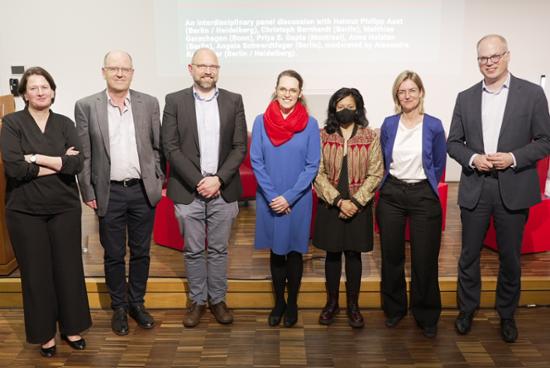
Cities are key drivers of climate change, but also central to its mitigation and adaptation. Last night at the Grimm-Zentrum in Berlin, MPIL's Heidelberger Salon featured an interdisciplinary dialogue on the role of cities in the global climate crisis, convened by our new director Helmut Philipp Aust and historian Christoph Bernhardt. The event brought together experts from law, history, geology, and geoecology to examine the conditions of urban resilience and the translation of climate science into actionable policy.
Following opening remarks by Helmut Aust and a keynote presentation by Matthias Garschagen, Christoph Bernhardt, Priya S. Gupta, Anne Holsten, and Angela Schwerdtfeger joined host Alexandra Kemmerer to explore these themes from their respective disciplinary backgrounds.
It was especially valuable to have Professor Garschagen join the discussion at a moment when the IPCC Special Report on Cities is moving through its finalization phase: a rare opportunity to discuss the report’s stakes for urban climate governance while its contours are still coming into view. In his keynote, Professor Garschagen emphasized that while urban adaptation efforts are rising globally, they still lack the "depth, scope, and speed" needed to offset increasing climate risks. Drawing on recent findings, he noted that many cities continue to plan on the basis of hazard projections without adequately integrating changing social conditions and local vulnerability into their approaches. He also highlighted that practical barriers remain "on the ground",including legal uncertainties around flood hazard mapping and a persistent gap between risk perception and concrete municipal action.
The discussion moved beyond technical mitigation to show how urban adaptation is deeply shaped by a city’s specific spatial and temporal context. Legal experts stressed that climate targets require robust administrative and international law to ensure accountability, while perspectives from history and the geosciences analysed the path-dependencies that dictate modern vulnerability. The conversation also addressed the importance of city networks as spaces for exchange and learning, as well as the need to take experiences from the Global South seriously: not as an add-on, but as essential to understanding how cities are already responding to climate pressure under highly unequal conditions.
The discussion also emphasized the importance of legal education and its role in training climate-conscious lawyers, highlighting the need to rethink how young lawyers are taught to integrate climate perspectives across all areas of law.
The evening also made clear why interdisciplinary conversation matters in this field: meaningful urban climate governance depends on sustained exchange across disciplines, methods, and regions.
A cooperation of Freie Universität Berlin, Humboldt-Universität zu Berlin, and the Max Planck Institute for Comparative Public Law and International Law (Berlin Office). Co-sponsored by the ILA Committee on Urbanisation and International Law - Potential and Pitfalls.