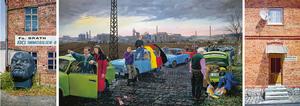
H.D. Tylle: Der 9. November 1989 in Deuna, am Morgen danach, 1999.
In Auftrag gegeben von der Max Dietrich und Monika Marlene Kley Kunststiftung, Leihgabe
Remarks on H.D. Tylle’s “9 November 1989 in Deuna, the Morning After,” delivered on the occasion of the ceremony on 14 February 2020.
Armin von Bogdandy, Heidelberg
We have come together today on the occasion of the installation of H.D. Tylle’s painting 9 November 1989 in Deuna, the Morning After. Let me warmly welcome you all. I would, however, like to mention four people in particular: Monika Marlene and Max Dietrich Kley, whose foundation owns the painting and has generously placed it at our disposal on loan; the painter himself, H.D. Tylle; and his wife, the author Brigitte Endres.
We are gathered here in the Institute’s extension, designed by the Berlin architect Volker Staab. Thanks to his work, our building has become part of Heidelberg’s circuit of tours on contemporary architecture. With Tylle’s painting, the foyer now gains another artistic accent, one fully equal to the architecture itself. At the same time, the work conveys an idea central to this Institute’s research. It reflects much of what has occupied us over the past seventy years, and it even suggests lines of inquiry for future research in comparative public law and international law.
Over the next half hour, I would like to describe the painting, offer an interpretation of it, and briefly explain why it provides such a concentrated point of access to our work, from the re-establishment of the Institute in Heidelberg in 1949 to the present day.
In 1999, the Max Dietrich and Monika Marlene Kley Foundation commissioned the artist to capture 9 November 1989 in a single painting. There were no specifications, except that the format should be worthy of the occasion. At 6.3 by 2.3 metres, it certainly is. We are fortunate that this makes it difficult to hang almost anywhere else, yet perfect for our foyer.
The painting has previously been shown, among other places, at the German Historical Museum in Berlin and at the Kunsthalle in Mannheim. On the occasion of those exhibitions, two experts, Klaus Schönmetzler and Eckard Wagner, published descriptions of the work online. I shall draw on their observations, but I would like to add two interpretations of my own: first, the understanding of truth that I see in Tylle’s realism; and second, more importantly, what I take to be the decisive stroke of the work, its real message.
The painting captures a historical moment: 9 November 1989. Today, that day is understood to be as momentous as the Peace of Münster and Osnabrück in 1648 or the storming of the Bastille in 1789: an event by which an epochal transition is marked. In that sense, this is a history painting, akin to Manet’s The Execution of Emperor Maximilian or Delacroix’s Liberty Leading the People, which recalls the second day of the French Revolution of 1830. We shall return to that painting in a moment, for Tylle quotes it in a light and ironic way.
Tylle’s work is a history painting in the style of realism. Yet what we see here never happened in precisely this way. The scene is an invention of the painter, just as it is in Manet and Delacroix. There is, however, one important difference. In Manet and Delacroix, it is obvious that events did not unfold exactly as shown. Here, by contrast, everything appears as though it might have happened just like this. But it did not. It is a fiction.
Still, it is a very particular kind of fiction: fiction in the service of truth. It is an invention of the kind Siegfried Lenz describes in the afterword to his collection So Tender Was Suleyken: Suleyken, he says, never existed; it is invented. But is that what matters? Is it not far more important that it might have existed? Certainly, the story exaggerates a little, but it exaggerates methodically, in such a way that what is singular stands out and what is characteristic comes into view. In that sense, exaggeration serves the search for truth.
What we see here, then, is a realist history painting that shows a reality no photograph ever captured, and probably never could have captured. Too many symbols converge here for that to be accidental. That gives us a standard by which to judge the work: it must be measured by whether it is, in some sense, more real than any photograph could ever have been.
The painter takes factual accuracy very seriously: the cars, the clothing, the landscape, the factory, the Playboy, the TUI catalogue. In 1999, the line of cars was even restaged with a Trabant club in period dress. Every detail is meticulously researched. But the whole, and that is what ultimately matters, is fiction.
What, then, do we see? Tylle uses the medieval form of the triptych, a three-part painting traditionally associated with religious meaning. Its tripartite structure allows different elements to be assembled into a single field of meaning. In the centre, we see 10 November 1989 on a road near Deuna in Thuringia; on the right and left, scenes near the same place ten years later.
On the horizontal axis we see the cement works and the village of Deuna. The cement works stretches across a full kilometre of uncompromising industrial skyline. Since it stands so close to the Wall, one may well suppose, with Max Dietrich Kley, that it produced cement for the Wall itself. In that sense, the works symbolise the GDR almost as effectively as a border watchtower. Next to it lies the village of Deuna, with its church, crouching low, much as social life in the GDR beyond state and party may often have done. In front lies a harvested field, an image of the barrenness of industrialised East German agriculture, and a leafless tree. It is the atmosphere of an autumn day, entirely real and at the same time symbolic: something is exhausted and coming to an end. Beyond, to the right, rise the wooded hills of the Dün, and above them an expanse of sky. The abundance of light, pushing back the dark clouds, shows that after this ending, life continues in hope.
On the vertical axis there is only one dominant motif: the East German metal lattice mast. Why this single, isolated object, emphasised so strongly, when the painter is by no means sparing elsewhere? Because, it seems to me, this mast brings the central message of the painting into focus. Remember: this is a triptych. That already suggests what is at stake. I shall come to that in a moment. But first, a word about the diagonal.
Along this classic and dominant diagonal runs the road on which the actual event unfolds. It is so simple that anyone can grasp it immediately. We are seeing East German citizens setting out for the West after hearing, during the night, that the Wall has fallen.
Along this road, the painting becomes densely symbolic, and in a cheerfully, gently ironic mode that is unfortunately not a common feature either of the German character or of German art. Tylle’s irony is all the more truthful and convincing because, even during the years of the GDR, he worked intensively with artists there and to this day shows genuine respect for the achievements of those who lived on the other side of the Wall.
The ninth of November was a departure. And what do we see? East German vehicles in a traffic jam. This departure into freedom took place in a real, indeed almost epic, traffic jam. People have got out of their cars, and the whole scene is full of symbols. Consider only the young woman standing on the roof of the Trabant with a flag. In her, one important aspect of the painting’s central message is especially clear. Think of Delacroix’s iconic Liberty Leading the People: a young woman with a flag dominates the image. Fearless, wearing a Jacobin cap and carrying a flying banner, she strides over the bodies of the regime’s dead henchmen at the head of an armed people. Set against this famous image, which we all somehow carry within us, the great message here becomes immediately clear: in 1989, everything is peaceful. Everyone waits patiently, and even the flag hangs rather limply. No wonder, given the hole left by hammer and compass.
Tylle’s painting breathes peacefulness. It was a real revolution, but a peaceful revolution. That is what we must remember, because this peacefulness was a miracle. Which of us, in 1988, would have believed that Soviet communism would surrender peacefully? Let us be clear about this: the painting tells of a great miracle. Its deeper meaning still remains to be explored, and the mast will help us. But first we need a fuller sense of the significance of the event itself.
At the lower right, we see a parked car already on its way back, loaded with bananas, an Aldi bag, a TUI catalogue, and a Playboy. Here Tylle identifies, with striking precision, the insignia of freedom for many people: good food, travel, freedom of information, freedom of opinion and desire, the ability to buy good products cheaply. And beyond all that: freedom from fear.
This day is a departure into freedom, and that means, first of all, that a regime that inspired fear has lost its authority. Here the painting is especially rich in cheerful, ironic symbols: the torn portrait of Honecker in front of which a small boy is relieving himself; the ripped poster for the fortieth anniversary of the GDR, which no one any longer cares about; and above all the desecrated flag, whose public display would almost certainly have amounted, under our law, to the criminal offence of insulting the state and its symbols. The loss of authority is so complete, and the new freedom from fear of the regime’s enforcers so fully realised, that no one around them even pays attention.
This departure is full of hope. We sense a good mood among the people. Above all, it is the light that leads us to that feeling. There are still grey clouds, but behind them shines sunlight, a radiant and promising autumn light.
What became of all this? That is what we see on the right and left, on the temporal plane ten years later. Tylle keeps his distance from apologists of every sort. We see neither blooming landscapes nor occupation troops from the Federal Republic coldly dismantling socialist achievements. The truth is expressed more quietly. On the right, we see a new beginning. The façade is renovated and glows in friendly sunlight. A new window, a satellite dish, a small American flag, and a company sign all point to a new self-reliance. One does not see much, yet one somehow gains the impression that someone lives there who has succeeded in building a modest but meaningful life, a life filled with light.
On the left, the picture is different: an unrenovated backyard, the office of a property company of a kind with which many people have had bad experiences, and the large head of Lenin. Authoritarianism has been cleared away, but it has not disappeared, as unfortunately we can once again observe today. There is much to notice here. That is one reason the painting hangs so well in our foyer: one constantly discovers something new in it, and from there a conversation can begin that readily leads to the kinds of research questions pursued at this Institute.
The painting is full of messages. But what brings them all together? That question leads us back to the mast. Let us recall the form: the triptych, a classical means of representing religious meaning. More precisely, Christian meaning. And in truth it is not really about a plurality of meanings, but about the one central message of Christianity. The painting takes up that message in its form and in all its details, and concentrates it in the central panel through an iconic Christian symbol.
Of course, Tylle does not paint a cross. But he paints a mast, and he places it almost exactly where the cross would stand in a medieval triptych. What does the cross signify?
It signifies the promise of redemption.
The ninth of November was many things, but above all, for very many people, it was a day of redemption: redemption from a harsh regime. But who was the redeemer? Or what redeemed them? Tylle does not tell us. He, or it, or she, remains above the image.
Many candidates present themselves: Ronald Reagan, who forced Soviet communism into ruin through rearmament; Mikhail Gorbachev, who allowed its peaceful collapse; Western liberal capitalism, which proved superior to Soviet communism in every respect and thereby stripped it of legitimacy; the normative programme of the liberal West, from the Basic Law to the European treaties, the European Convention on Human Rights, and the UN Charter, in other words the very subject matter of this Institute’s research; the courage of East German citizens and the prudence with which they shaped their revolution; or perhaps, after all, the grace of God.
Now you may say: this is going too far. And indeed, to many ears this religious dimension may sound almost absurd. But let us not forget that every Sunday, in churches, thousands of people pray intercessions: that migrants may not drown in the Mediterranean, that the war in Syria may end, that the followers of Pegida may overcome their hatred, and before 1989, in many churches in East and West alike, that the confrontation between East and West, which threatened life on this planet, might be overcome. Such prayers always end with the appeal: “Lord our God, we ask you, hear us.” Are they all fools?
Even the political Left has said that the peaceful revolution was a gift from heaven. Perhaps it is right.
H.D. Tylle will speak in a moment. But I do not think he will reveal what the upper part of the mast carries beyond the edge of the painting. If he did, he would deprive the work of its ultimate message, and it is with that message that I would like to conclude.
What is the ultimate message of this mast, whose tip we cannot see? It lies in the fact that anyone may project their own faith in redemption into the painting and anchor it above the frame, at the top of the unseen mast. Like every event of world-historical significance, German unification generates many interpretations and many narratives. But anyone with a little imagination will also see that the mast can symbolise another faith in redemption entirely. And one then understands that there is no method by which we can finally determine who is right. This self-doubt, this recognition that the sometimes irritating views of others may nonetheless have a rightful, even indispensable, place, is the strongest foundation of freedom as we understand it. And that is why the true stroke of genius in this liberal realism is that it conceals what matters most.
Let me close with a few words on why this painting is such an apt symbol of the research conducted in this building. For that, one needs to know a little about the Institute itself. Like so much in Germany, it derives its self-understanding from the fact that Germany lost two world wars. The Institute was founded after the First World War in order to build the scholarly expertise needed to deal with the many legal questions arising from the Treaty of Versailles. Germany was left with an army of only one hundred thousand men. At that moment, effective lawyers were in demand.
Nothing symbolises the lost Second World War more than the division of Germany. That division produced a vast number of legal questions, and they lay precisely within the Institute’s field: the Federal Republic’s claim to sole representation of Germany, the status of West Berlin, the legal nature of the GDR, the many questions surrounding Ostpolitik and détente, but also European integration, NATO, and West Germany’s gradual incorporation into a West led by the United States as hegemonic power.
Then came the fall of the Wall. Once again, an event in German history marked a turning point in world history, like the storming of the Bastille or the two lost wars. A German event as a world-historical caesura, but this time a positive one. Our research programme responds directly to that moment, for example in its concern for deepening European integration: the aim is not a German Europe, but a European Germany. At the same time, we study the global dimension with equal intensity, for the fall of the Wall also stands for the breakthrough of a US-led globalisation, with its many new forms of global governance and humanitarian intervention. That epoch has now come to an end, and we are currently grappling with how the lessons of two lost wars can be absorbed in an uncertain future.
The painting offers clues for this as well, and I will mention only two in closing. Where should the road lead? In the painting, it leads west. For all the dangers we see in the United States, and also in France, the West remains symbolically secure for us: we are guided by the idea of liberal democracy. And what is most important in that? This brings us back to the painting’s central message: a constant willingness to doubt one’s own conclusions, and the insight that the ideas of others, however irritating they may sometimes seem, may nonetheless have a rightful, indeed indispensable, place.